Chris Minns on the Truth of the Matter
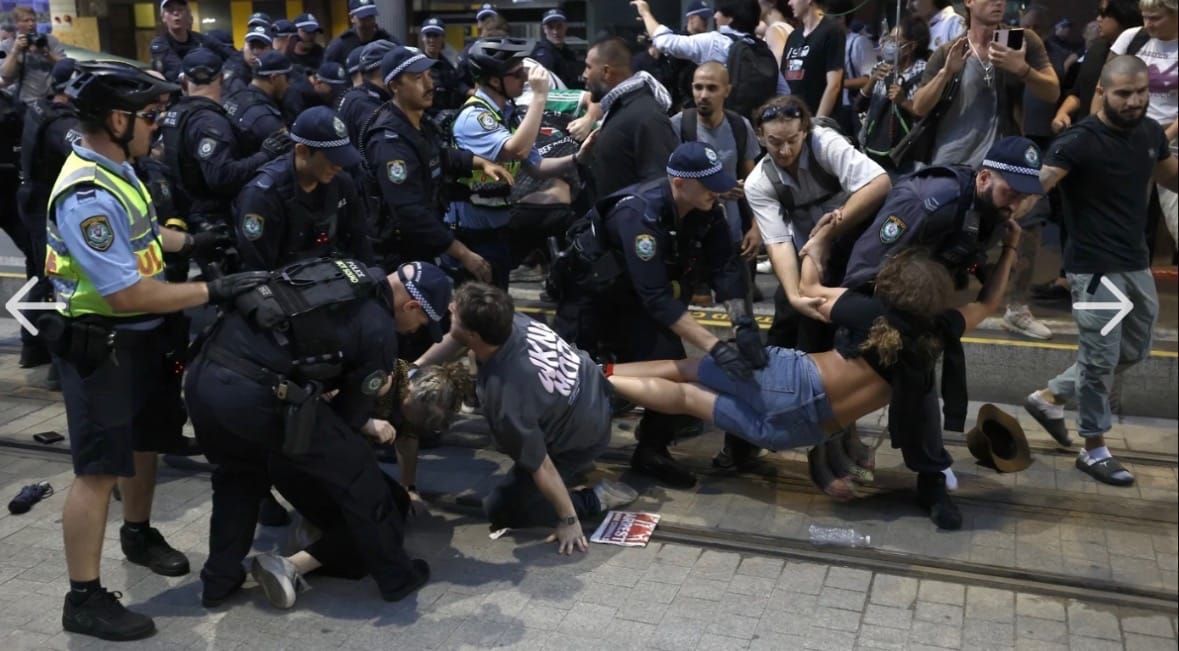
The morning after my sister is hurled through the air by a police officer, my mum sends me the photo. I receive it on the 7am train and for a moment, I can’t discern what I’m seeing. The photograph is baroque, dozens of figures, protesters, police, people clutching their phones with their eyes bright. But there, in the thick of it, is the back of my sister’s head. The photographer has captured the exact moment that she is suspended above the tram tracks on George Street, one block from the end of my commute. There is one officer stumbling at her feet, and another caving over her like a wave; the vanguard to the buzzing cloud of blue has consumes the left side of the photo.
Her boyfriend, Max, is there. Their arms are locked together, hands grasping at biceps as she falls. It's almost romantic. He stands behind the tackling police, wearing one of those backpacks that buckles over your chest and a short-sleeve button down shirt. He looks like an office worker with a very confused commute. But he holds onto her, even though there will be no time before the camera flash fades and they crash onto concrete. And she holds back, there in Town Hall wearing her denim shorts and black t-shirt, with her hair in pigtails. The photo lends her a kind of grace, as if she hasn’t just been rugby tackled in the street. I am glad, quietly, that you can’t see her face.
I receive this photo and stare at it for a long while.
I’m not very close with her. Things happened when we were teenagers that pushed our growth in opposite directions, and we’ve never been able to come back together, not really. But I grieve the type of family we could have been. We receive updates on each other via public broadcast like rival politicians. Very occasionally my office will reach out to hers, memorandums of understanding exchanged. The photo crosses some threshold and I, in a panic, send her an UberEATS gift card and tell her that she doesn’t have to text me back. I go back to the photo.
This time I notice her string bag, falling with her, probably full of the loose detritus of her life; tabacco packet (she rolls her own), lighter, hair ties, phone. In the left half of the photo someone else’s kid is crumpled, head bent beneath the oncoming wave of police officers. One of them is reaching down to her, and if you didn’t know the violence of this moment, the gesture would appear gentle, as if she’s just fallen and he will take her hands, raise her to her feet and dust her off. Next to her is a young man, knelt by her side with his gaze up on another officer. Sometime today, their parents will become discover this photo, they will send it around to friends and relatives all slack-jawed and unsettled. They will discover the photo over and over again as I have done, headlining articles recounting the movements of the wave as it surged over young people and pensioners alike.
This is not to make some trite statement about how every protester is someone’s baby, but because it is striking to me. I have always subscribed to the all-cops-are-bastards school of thought because I think it is accurate, because I am an Aboriginal woman from an Aboriginal family, I work in the Aboriginal health sector, and because they are. It is well within my expectation of NSW police to beat the shit out of a bunch of protesters for no reason. But I am the centre of my own universe and that’s my sister. I once threw a rock at her head, she plays Waluigi in Mario Kart, she tells my mum that she won’t be eaten by a shark because her wetsuit has a tear in it. My sister is an inner-west dirt bag and what the fuck is she doing as the headliner for this ABC article that pulls it’s punches like its budget isn’t the healthiest it’s been in years.
But there she is, and here I am, sitting on the morning train, thinking about how some head injuries won’t show up for half a day or more, thinking about how pepper spray can burn a hole in your cornea.
When I get into work that morning, I can’t hold a thought long enough to decide if I’m frightened or proud. Instead, I spend my time interrupting conversations; ears pricked for discussion of the previous night’s events, launching myself across rooms to show people the photo. “That’s my sister,” I say pointing “she’s okay, but she got a bit of a fright.” Truth be told, I don’t know whether she had gotten a fright, but it feels correct to say because I’m talking about myself.
…
Later that afternoon, a ministerial meeting is postponed, and it takes me an embarrassingly long time to figure out that it’s because they want all the MPs present for question time. “It’s a sitting week,” an inter-agency colleague blusters, “sometimes they’ll have to reschedule on a sitting week.”
The opposition leader, Kellie Sloane, starts with a question that will reveal nothing but has the cadence of politics. I can imagine her in parliament, leaning over the table and waggling her eyebrows as she asks, if his MPs will not listen to him, how does he expect the people of New South Wales to listen to him? She’s trying a little too hard. Chris Minns parries effortlessly by bringing up Orwellian thought crimes because he’s a fucking professional. She tries to call for a point-of-order, to which he responds, I could hardly be more relevant. It could hardly be easier. He brings up the Coalition record of parliamentary rebellion and with what I assume is a shrug states, and I did not think it was that big of a deal, which is a barb with layers but no substance. Its all performance, from both of them. The Coalition has no comfortable place in this conversation. They won’t question the behaviour of police or the deservingness of the protesters, but they must be seen to have made a challenge. The Labor party sits on the other side of the chamber like a pig in mud, smug and deep in the weeds.
From here on in, the Labor party is playing chess with its own reflection.
The member for Prospect, an old school Labor MP who spent his youth as a jackaroo in central Queensland before discovering politics and the thrill of losing your integrity, gets to ask the next question, perfectly rehearsed. He asks for an update on the work of NSW police the night before, ensuring the safety of mourners, protesters, and the broader community? He might as well have asked Minns to tell the chamber how well he satisfied his wife last night. But it gets things going.
Minns states, the NSW police did everything they possibly could to avoid a conflict, and the Greens cross bench explodes onto the transcript like greyhounds tearing after the metal rabbit.
I imagine the member for Newtown, Jenny Leong, leaning over the back of the front bench as she stands with blazing eyes and a shaking fist ,crying over the ruckus, that is factually incorrect, Premier. There are rarely any exclamation points in the Hansards, but I have to imagine that she raised her voice. In my imagination, one day the revolution will come and Jenny Leong will snap. She'll light a molotov cocktail off her lit cigarette and throw it through a parliamentary window as she stands in the terrible blaze of the CBD. For the time being, she sharpens her teeth on the Minns Government.
The chamber falls into disarray, even as the speaker, Greg Piper, bangs his gavel and threatens removal, and Minns pretends it has affected him terribly, is it going to be constant abuse, Mr Speaker? As he tries to continue, the Greens take turns attracting the attention of the speaker, like sheep dogs nipping at heels, every time one of them is shot down another pops up. There is a ruthlessness to them that makes me almost romantic. They have real teeth, chasing the premier around the chamber while he spits lies over his shoulder about two separate attempts to breach police lines, and clashes on Sydney streets. Clashing is an interesting word he uses more than once.
Eventually Minns is given the room to start finishing his sentences without interruption and he begins his delicate work. To answer the question, he must weave a lovely tapestry, strung together from recycled rhetoric and complete fiction. In the Minns imagination, the NSW police did nothing but hold the line between fragile mourners and far-left nut bags. He proposes the violence of police not as an unfortunate result of avoidable circumstance, but as a criterion of peace. The protesters are unreasonable, they are wilful, and cynical, they are a threat that must be eliminated, and there is no easier way to turn a protester back into a person than by throwing them to the ground. The government has no obligation to acknowledge the political dissent of a person who has been pepper sprayed. Only criminals get pepper sprayed.
Minns keeps saying that is the truth of the matter. He says it three times in as many statements, like he’s trying to hypnotise the stenography clerks. But he can’t pull it off. He performs this authenticity like a primary school principal, shaking his finger at imaginary protesters, but it just sounds pathetic. Everyone in that chamber knows the reputational pressure he’s under, the weight of the narrative, the election year that is always around the corner. It is for the best that the likes of the Palestine Action Group are confined back to the fringes of acceptable discourse. They are madhouse SJWs, getting all upset about things that just aren’t that serious, bad actors endangering police and causing unnecessary disruption because they just love protesting so much and they got what was coming to them. My sister skids across the concrete.
Minns does what he has to.
The Liberal Party gets their turn again and it’s over as quickly as it starts, another question about how Minns feels about those in his party with extracurriculars on Monday evenings, if they still have his confidence. Minns elects to answer a completely different question that he’s imagined from whole cloth, and for reasons unknown the speaker lets him, striking down the chirps of the opposition as they stammer out points-of-order.
The next question is from the Labor member for Mount Druitt. It’s another update question, directed to Yasmin Catley, the Minister for Police and Counter Terrorism. With that portfolio I’m sure she’s had a rough few months, some long nights, but it’s important to remember that she also thinks it’s actually really important that NSW Police retain their power to strip-search children.
She is unflinching in her support of police. Where Minns is a weaver of tapestries, Cately walks down a corridor locking doors behind her like a prison guard. Guarantees were given by PAG that they would not march. But they are bad-faith actors. It’s a plain, utilitarian approach.
There is nothing here to hide, she says, building certainty like a bricklayer. She creates a reality where her contempt for protesters is reasonable, where threats to social cohesion lurk in every shadow and noble policemen tipping their hats to old ladies are attacked from behind. Police negotiated, and pleaded with protesters, they did everything they could and still those protesters were determined to defy police’s orders and be violent towards the NSW South Wales Police.
Her language is so broad, so unforgiving that I go looking for her history, trying to find some reason why she would chain herself to this particular fence. But there’s nothing. She was a librarian and then she was a politician and she will defend violence without question. I think I would find it distressing to sit across from her, but she’s the one I would interview. I want to know how she got here; I want to know what it is about this violence that is palatable to her, how it came to be that way, how I can stop it happening to other people.
Jenny Leong with her molotov cocktail in hand, uses her last warning from the speaker to yell her dissent across the chamber, because she must, because the opposition won’t. She is removed, and I grieve her absence from the transcript.
The series of questions goes nowhere, because they aren’t the right questions. There is no mention of the special ‘move-on’ powers utilised by police, no mention of the Muslim men torn off the street while they prayed, there is no mention of the protest laws put in place by the Minns government. There is no mention of how highly publicised police violence will go on to impact community safety in the future, no mention of how the NSW state government in all their glory created the very circumstances where the normal act of protest must be met with absolute destruction. There is no mention of how the NSW police force is either under the control of the NSW government or it’s not, they either did a bad job under government instruction, or they did a bad job the way a rabid dog gets off a leash. Instead, the premier and his cabinet faff around with unimportant details, posturing and lying as they trying to create the impression that they simultaneously have complete control over the situation and can’t be held accountable for any of it.
The only thing of any consequence is that my fucking meeting is rescheduled until the next day which is annoying for me personally.
…
Weeks later, and all the thinking has trailed off. At a family gathering, the birthday girl, to be eighty the next day, looks to my sister in a discussion about police, wryly stating that she would know more about that than the rest of us. It is becoming a footnote.
I still don’t know my sister’s experience, I haven’t spoken to her about it, I don’t know if she was scared, I suspect she wasn’t. It has always been her way. Under pressure she stiffens, she grows a thick concrete shell, she gets denser the more she is moved. I have become the sensitive one of the bunch, wrung hands and concern, returning to the violence like I’m holding my hand over a candle, checking to see if it’s still hot.
A few days after the protest, the Law Enforcement Conduct Commission (LECC) announced that they will be investigating the conduct of police at the protest. I had been waiting for the announcement to come because it was inevitable and when it came, I felt sick. The LECC is the service station flowers, the NSW government is your shitty boyfriend, and the NSW electorate is the sucker that opens the door. The outrage of the general population is hard to maintain when it feels like an official is there to take care of it. An entity who’s job it is to deal with this sort of thing.
Why keep looking when investigation will take place, imaginary civil servants with clipboards, in short sleeved white button down shirts and black ties will march through the streets of Sydney and figure out exactly what happened. They will enter the videos and the photo of my sister into the evidentiary record, they will track down some specific officers, talk to the police commissioner and to Catley. In six months, or probably longer, they will produce a one-hundred-and-fifty-page report that will meticulously go over the events of the evening and then the faceless arbiters of truth will hand down a ruling that is absolute. If they find no serious misconduct, there is no serious misconduct. And they won’t. That is the job of the LECC.
In 2021 they published a report about the serious injuries suffered by a fourteen-year-old Aboriginal boy who was frightened, and who ran. He was tackled, rammed into the side of a shipping container, held down by four officers and struck in his head and neck. The boy had been cornered before he was tackled, and the officers knew where he lived. They could have let him go; they could have let him run knowing that he’s a fourteen-year-old kid and he was always going to end up back at his mum’s house. Instead, they gave him facial lacerations so deep they went down to the bone.
And the LECC found no serious misconduct. Because that’s the job.
But I’ll know. My sister knows, my dad has always known, Jenny Leong knows, the birthday girl, my colleagues, the people who got caught between police violence and the train station, the protesters, and the speakers. There is no promise that the attention is good, that the witness we bear will be helpful, but someone must do it. That’s the job.